

If you are planning to live in Spain for more than 90 days, understanding the right residency route is an essential first step. In this guide, we explain the main types of Spanish residency permit, the general requirements, and the application process so you can move forward with greater clarity and confidence.
A Spanish residency permit is the legal authorization that allows foreign nationals to live in Spain for more than 90 days under a specific immigration route.

It gives you legal residence in the country and, depending on the type of residence authorization, it may also allow you to work, study, join family members, or carry out professional activity.
For anyone planning a medium or long stay, the residency permit is the document that defines your status in Spain and the conditions attached to it.
This residence permit in Spain is usually linked to a clear purpose, such as employment, self-employment, remote work, family reunification, or sufficient economic means.
A Spanish visa and a Spanish residency permit are related, but they are not the same. When we speak about a visa, we refer to the document that allows you to enter Spain for a specific purpose.
When we speak about a residency permit, we refer to the authorization that allows you to live in Spain legally for more than 90 days under an approved immigration route.
For many foreign nationals, the process begins with a visa application at the Spanish consulate in their country of residence. Once in Spain, the relevant residence authorization confirms their legal residence and, depending on the case, may include the right to work, study, or join family members.
We want to explain this difference clearly because it affects the documents you need, the place where you apply, and the steps you must follow to secure residency in Spain.
As we have explained, you will usually need a Spanish residency permit if you plan to live in Spain for more than 90 days and you are not covered by a short-stay visa or visitor status.
This applies mainly to non-EU citizens who want legal residence in Spain for work, self-employment, remote work, family reunification, or any other long-term purpose recognised by Spanish immigration rules.
For EU citizens, the route is different. The requirement is often based on registration rather than a standard residence permit in Spain, although the stay still has to be formalised when you move to Spain on a stable basis.
When we review a case, one of the first points we look at is your nationality, the length of your stay, and the reason why you want to live in Spain, because those factors determine the correct residence authorization.
Need Help Getting Your Spanish Residency Permit in 2026?
At Díaz & Asociados we help you obtain your Spanish residency permit, guiding you through the requirements, documentation and application process so you can move to Spain without complications.
As reflected in Spain’s Immigration Portal and the current Immigration Regulations, the right Spanish residency permit depends on your nationality, your purpose for moving, and the activity you plan to carry out in Spain.
When we assess a residence authorization, we usually start with the legal basis of the stay and the documents that support the application.
| Type of permit | Who it is for | Main purpose |
|---|---|---|
| Non-Lucrative Residence Permit | Non-EU nationals with sufficient financial means | To live in Spain without working in the country |
| Work Residence Permit | Non-EU nationals with a job offer from a Spanish employer | To live and work in Spain as an employee |
| Self-Employed Residence Permit | Non-EU nationals planning to carry out an independent professional or business activity | To live in Spain and work on a self-employed basis |
| Digital Nomad Permit | Remote workers and certain professionals working for companies or clients based abroad | To live in Spain while carrying out remote work |
| Family Reunification Permit | Eligible family members of foreign nationals already holding legal residence in Spain | To join relatives and obtain legal residence in Spain |
| Residence as a Family Member of an EU Citizen | Certain relatives of EU citizens living in Spain | To reside in Spain on the basis of the family link |
| Long-Term Residence | Foreign nationals who have completed the required period of legal residence in Spain | To obtain a more stable residence status |
For further information, you can consult the Spanish Government’s Immigration Portal at https://www.inclusion.gob.es/web/migraciones/autorizaciones. If you would prefer advice tailored to your situation, you can also contact us and we will explain your case to you in English.
The right Spanish residency route depends on your nationality, your source of income, and the reason why you want to live in Spain. When we assess this question, we focus on your personal circumstances first, because the correct residence authorization has to match the activity you will carry out and the documents you can provide.
Across the current Spanish immigration framework, many applications for a Spanish residency permit share the same general documentary base.
We begin by checking your identity documents, your immigration background, and the evidence that supports the residence route you want to follow, because those elements define the rest of the application.
Most applicants will need the relevant official application form and a valid passport or travel document.
You will also need documents that support the purpose of your residence in Spain, such as proof of sufficient financial means, a job offer, evidence of a professional or business activity, or documents proving the family relationship in family-based applications.
Depending on the route, you may also need health insurance, a criminal record certificate covering the previous five years, a medical certificate, and proof that the relevant government fee has been paid.
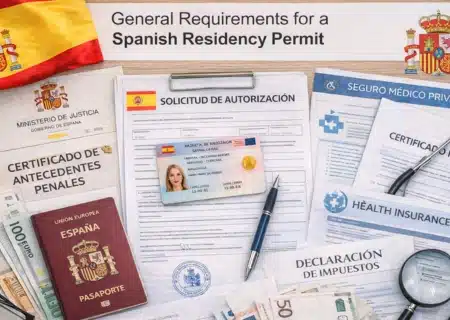
The exact supporting documents vary from one residence permit in Spain to another, so it is always worth reviewing the specific route before submitting the application.
Need Help Getting Your Spanish Residency Permit in 2026?
At Díaz & Asociados we help you obtain your Spanish residency permit, guiding you through the requirements, documentation and application process so you can move to Spain without complications.
The exact procedure depends on the residence route you choose, but most applications follow the same general sequence. We recommend starting with the correct legal route, because the application form, the supporting documents, the place of filing, and the next steps all depend on that first decision.
Given the complexity of Spanish immigration procedures and the language barrier many applicants face, we recommend booking a call with us so we can assess your case in English and guide you through each step with clarity and confidence.
The processing time for a Spanish residency permit depends on the route you apply for. Under the current Spanish immigration framework, many initial residence and work applications are subject to an official decision period of up to three months, while the non-lucrative residence route is resolved within up to one month from the consular communication to the competent authority.
When we review a case, we look first at the specific residence authorisation, because that is what determines the formal processing period and the next steps in your application.
Under the current Spanish immigration framework, temporary residence authorisations are granted for a limited period, and the renewal rules vary depending on the permit you hold. For that reason, we always review the exact route before advising you on timing, documents, and next steps.
As a general overview, renewed non-lucrative residence authorisations are usually granted for two years, while renewed work, self-employed, and family reunification authorisations are generally granted for four years.
Long-term residence gives you a more stable status in Spain, although the foreigner identity card linked to that status must still be renewed periodically.
Need Help Getting Your Spanish Residency Permit in 2026?
At Díaz & Asociados we help you obtain your Spanish residency permit, guiding you through the requirements, documentation and application process so you can move to Spain without complications.
Yes. If you hold a temporary Spanish residency permit and maintain legal residence over time, that permit can become the route that leads you to long-term residence in Spain.
Under Spain’s Immigration Regulation approved by Royal Decree 1155/2024, foreign nationals who complete the required period of legal and continuous residence may apply for long-term residence, a status commonly referred to as permanent residency.
As a general rule, long-term residence is available after five years of legal and continuous residence in Spain. Once granted, it allows you to reside and work in Spain indefinitely under the same conditions as Spanish nationals.
In many Spanish immigration procedures, foreign public documents must be legalised or carry an apostille, unless an international agreement provides otherwise. Documents in a foreign language will generally need an official translation into Spanish.
We always recommend checking this point carefully before filing, because documentary issues are one of the most common reasons for delays.
In some cases, yes. The Spanish administration allows certain immigration applications, renewals, and additional filings to be completed online through the official electronic systems.
The available route depends on the permit and on the filing channel open for that procedure.
If your residence route requires a Tarjeta de Identidad de Extranjero, you will need to apply for it in person before the National Police within the relevant deadline. For many permits, this is the document that proves your legal residence in Spain after approval.
Yes, Spanish immigration law includes procedures that allow certain applicants to modify their residence status from one route to another, provided the legal requirements for the new authorisation are met.
Whether this is possible in your case will depend on your current permit, how long you have held it, and the route you want to move into.
When a renewal, extension, or modification is filed correctly, the previous authorisation can remain valid while the procedure is being decided.
This gives applicants greater legal security during the waiting period and, where applicable, allows them to continue working under the conditions recognised by the rules in force

Abogado colegiado en el Ilustre Colegio de Abogados de Málaga, especializado en Derecho Penal y Extranjería, con un enfoque riguroso y orientado a la resolución eficaz de asuntos legales para clientes nacionales e internacionales.
¿ Necesitas ayuda?